AnasSarkiz/magnetic-shutter-remote-r8
A USB‑C rechargeable battery-powered ESP32‑C3 wireless controller with Li‑ion charging, protected 3.3‑V buck‑boost regulation, thermal/safety monitoring, status LEDs, buttons, programming UART, crystal clock, and 2.4‑GHz antenna matching network.
- Version
- 0.4.0-prototype
- License
- unset
- Stars
- 0
scripts/review-r9-power.py
"""R9 bare-chip nominal routed power-path measurements, not a hardware current test."""
import importlib.util
import json
import argparse
import heapq
import math
import hashlib
import sys
from pathlib import Path

ROOT = Path(__file__).resolve().parents[1]
SPEC = importlib.util.spec_from_file_location('power_geometry', ROOT/'scripts/manufacturing-audit.py')
GEOMETRY = importlib.util.module_from_spec(SPEC)
sys.modules[SPEC.name] = GEOMETRY
SPEC.loader.exec_module(GEOMETRY)


def switching_current_budget(params):
    # Sunlord SWPA3015S1R5NT table: 1.5uH +/-30%, not +/-20%.
    # TI SLVS696D equations 2/3 and 2.2MHz minimum. Triangular ripple RMS.
    minimum_inductance_h = 1.5e-6*(1-0.30)
    boost_duty = 1 - params['input_floor_v']/3.533
    boost_ripple = params['input_floor_v']*boost_duty/(2_200_000*minimum_inductance_h)
    buck_duty = 3.169/4.1205
    buck_ripple = (4.1205-3.169)*buck_duty/(2_200_000*minimum_inductance_h)
    return {'minimum_inductance_h': minimum_inductance_h, 'minimum_frequency_hz': 2_200_000,
            'nominal_inductance_h': 1.5e-6, 'inductance_tolerance_fraction': 0.30,
            'boost_ripple_peak_to_peak_amps': boost_ripple,
            'buck_ripple_peak_to_peak_amps': buck_ripple,
            'rms_design_amps': max(math.hypot(params['input_amps'],boost_ripple/math.sqrt(12)),
                                   math.hypot(0.5,buck_ripple/math.sqrt(12))),
            'peak_design_amps': max(params['input_amps']+boost_ripple/2,0.5+buck_ripple/2)}


def inductor_rating_failures(switching):
    failures = []
    if switching['rms_design_amps'] >= 1.7:
        failures.append('Normal switching-current estimate exceeds qualified inductor RMS rating')
    if switching['peak_design_amps']*1.2 >= 2.3:
        failures.append('Inductor saturation rating does not retain TI recommended 20% peak-current headroom')
    return failures


def width_budget_failures(paths, budgets):
    return [f'{name}: nominal power neck is insufficient for its current budget'
            for name,current in budgets.items()
            if paths[name]['ipc2221_external_estimate_10c_amps'] < current]


def load_path(params):
    features = [f for f in params['copper'] if f.net == params['net']]
    circuit = params['circuit']
    owners = {e['pcb_component_id']: e['source_component_id'] for e in circuit if e['type'] == 'pcb_component'}
    components = {e['source_component_id']: e['name'] for e in circuit if e['type'] == 'source_component'}
    pads = {e['pcb_smtpad_id']: e for e in circuit if e['type'] == 'pcb_smtpad'}
    endpoints = []
    for reference, pin in params['terminals']:
        matches = [i for i,f in enumerate(features) if f.kind == 'smt' and components[owners[f.owner]] == reference and pin in pads[f.id]['port_hints']]
        if len(matches) != 1:
            raise ValueError(f'Power terminal is not unique: {reference}.{pin}')
        endpoints.append(matches[0])
    adjacent = [[] for _ in features]
    for i, first in enumerate(features):
        for k, second in enumerate(features[:i]):
            if (first.layer == second.layer and first.geometry.intersects(second.geometry)) or (first.id == second.id and first.kind == second.kind == 'annulus'):
                adjacent[i].append(k)
                adjacent[k].append(i)
    queue = [(0, endpoints[0], [endpoints[0]])]
    visited = set()
    while queue:
        resistance, i, route = heapq.heappop(queue)
        if i in visited:
            continue
        visited.add(i)
        if i == endpoints[1]:
            tracks = [features[k] for k in route if features[k].kind == 'track']
            minimum = min(params['track_widths'][t.id] for t in tracks)
            return {'terminals': params['terminals'], 'features': [{'id':features[k].id,'layer':features[k].layer} for k in route], 'trace_only_resistance_upper_bound_20c_ohm': resistance, 'minimum_trace_width_mm': minimum, 'ipc2221_external_estimate_10c_amps': 0.048*10**0.44*((minimum/0.0254)*(0.035/0.0254))**0.725}
        for k in adjacent[i]:
            weight = params['track_resistances'][features[k].id] if features[k].kind == 'track' else 0
            heapq.heappush(queue, (resistance+weight, k, route+[k]))
    raise ValueError('No physically connected power path')


def review(output=ROOT/'evidence/R9-routing-2026-10-13/power-path-measurements.json'):
    source = ROOT/'dist/index/circuit.json'
    circuit = json.loads(source.read_text())
    if any(e['type'].endswith('_error') for e in circuit):
        raise ValueError('Power review requires an error-free routed circuit')
    boot_pullup = next(e for e in circuit if e['type']=='source_component' and e['name']=='R16')
    if boot_pullup.get('resistance') != 10000 or boot_pullup['manufacturer_part_number'] != '0603WAF1002T5E' or boot_pullup['supplier_part_numbers']['jlcpcb'] != ['C25804']:
        raise ValueError('Thin boot pull-up feed requires the exact reviewed10k/1% R16')
    boot_pullup_current = 3.533/(10000*.99)
    charge_feed = next(e for e in circuit if e['type']=='source_component' and e['name']=='R4')
    if charge_feed.get('resistance') != 1000 or charge_feed['manufacturer_part_number'] != '0603WAF1001T5E' or charge_feed['supplier_part_numbers']['jlcpcb'] != ['C21190']:
        raise ValueError('Thin charge LED feed requires the exact reviewed1k/1% R4')
    charge_feed_current = 4.1205/(1000*.99)  # Conservative even for a shorted LED.
    copper, _, _ = GEOMETRY.make_features(circuit, 'gerber')
    membership = {e.id: e.net for e in copper if e.kind == 'track'}
    names = {e['subcircuit_connectivity_map_key']: e['name'] for e in circuit if e['type'] == 'source_net'}
    segments = []
    for trace in (e for e in circuit if e['type'] == 'pcb_trace'):
        if trace['pcb_trace_id'] not in membership:
            if len(trace['route']) == 1 and trace['route'][0]['route_type'] == 'wire':
                continue  # Two existing breakouts may already be the same point.
            raise ValueError('Unattributed nonzero routed trace')
        name = names[membership[trace['pcb_trace_id']]]
        if name not in ['USB5V', 'VBAT', 'V3', 'RADIO_3V3', 'INDUCTOR_L1', 'INDUCTOR_L2']:
            continue
        for a, b in zip(trace['route'], trace['route'][1:]):
            # Match the qualified converter's discrete start-aperture semantics.
            if a['route_type'] == 'wire':
                start, width = a, a['width']
                end = b['start'] if b['route_type'] == 'through_pad' else b
            elif b['route_type'] == 'wire':
                start = a['end'] if a['route_type'] == 'through_pad' else a
                end, width = b, b['width']
            else:
                continue
            length = math.hypot(end['x']-start['x'], end['y']-start['y'])
            if length:
                segments.append({'net': name, 'trace': trace['pcb_trace_id'],
                                 'length_mm': length, 'width_mm': width,
                                 'resistance_20c_ohm': 0.00001724*length/(width*0.035)})
    summaries = {}
    for name in ['USB5V', 'VBAT', 'V3', 'RADIO_3V3', 'INDUCTOR_L1', 'INDUCTOR_L2']:
        subset = [s for s in segments if s['net'] == name]
        if not subset:
            raise ValueError(f'No measured segments for {name}')
        width = min(s['width_mm'] for s in subset)
        summaries[name] = {'minimum_width_mm': width,
                          'summed_branch_length_mm': sum(s['length_mm'] for s in subset),
                          'all_segments_series_resistance_20c_ohm': sum(s['resistance_20c_ohm'] for s in subset),
                          'ipc2221_external_estimate_10c_amps': 0.048*10**0.44*((width/0.0254)*(0.035/0.0254))**0.725}
    # Every branch in series overestimates the actual route resistance. Assume
    # 50C copper and a conservative -3% regulator budget; do not imply testing.
    resistance_factor = 1 + 0.00393*30
    track_resistances = {s['trace']: sum(row['resistance_20c_ohm'] for row in segments if row['trace'] == s['trace']) for s in segments}
    track_widths = {s['trace']: min(row['width_mm'] for row in segments if row['trace'] == s['trace']) for s in segments}
    paths = {}
    for path_name, name, terminals in [
            ('V3', 'V3', [('U3','pin1'),('L2','pin1')]),
            ('BOOT_PULLUP_FEED', 'V3', [('R15','pin1'),('R16','pin1')]),
            ('CHARGE_LED_FEED', 'VBAT', [('U2','pin2'),('R4','pin1')]),
            *[(f'V3_PIN{pin}', 'V3', [('U3','pin1'),('U1',f'pin{pin}')]) for pin in [11,17,31,32]],
            *[(f'RF_PIN{pin}', 'RADIO_3V3', [('L2','pin2'),('U1',f'pin{pin}')]) for pin in [2,3]],
            ('VBAT', 'VBAT', [('J2','pin2'),('U3','pin5')]),
            ('USB_VBUS1', 'USB5V', [('J1','pin15'),('U2','pin10')]),
            ('USB_VBUS2', 'USB5V', [('J1','pin16'),('U2','pin10')]),
            ('BATTERY_CHARGE', 'VBAT', [('U2','pin2'),('J2','pin2')]),
            ('INDUCTOR_L1', 'INDUCTOR_L1', [('U3','pin4'),('L1','pin2')]),
            ('INDUCTOR_L2', 'INDUCTOR_L2', [('U3','pin2'),('L1','pin1')])]:
        net = next(key for key,n in names.items() if n == name)
        paths[path_name] = load_path({'copper':copper,'circuit':circuit,'net':net,'terminals':terminals,'track_resistances':track_resistances,'track_widths':track_widths})
    supply_resistances = [paths[f'V3_PIN{pin}']['trace_only_resistance_upper_bound_20c_ohm'] for pin in [11,17,31,32]]
    supply_resistances.extend(paths['V3']['trace_only_resistance_upper_bound_20c_ohm'] + 0.09 + paths[f'RF_PIN{pin}']['trace_only_resistance_upper_bound_20c_ohm'] for pin in [2,3])
    chip_floor = 3.169 - 0.5*resistance_factor*max(supply_resistances)
    # Retain the earlier static tolerance envelope and use 80% efficiency.
    # Solve I*(Vbattery-I*R)=P/efficiency, including the actual copper drop.
    input_resistance = resistance_factor*paths['VBAT']['trace_only_resistance_upper_bound_20c_ohm']
    input_power = 3.533*0.5/0.8
    discriminant = 3.003**2-4*input_resistance*input_power
    if discriminant <= 0:
        raise ValueError('No valid trace-only battery operating point')
    battery_input_current = 2*input_power/(3.003+math.sqrt(discriminant))
    regulator_input_floor = 3.003 - battery_input_current*resistance_factor*paths['VBAT']['trace_only_resistance_upper_bound_20c_ohm']
    switching = switching_current_budget({'input_floor_v':regulator_input_floor,
                                          'input_amps':battery_input_current})
    budgets = {**{f'V3_PIN{pin}':0.5 for pin in [11,17,31,32]}, **{f'RF_PIN{pin}':0.5 for pin in [2,3]}, 'V3':0.5, 'VBAT':battery_input_current, 'USB_VBUS1':0.4,
               'USB_VBUS2':0.4, 'BATTERY_CHARGE':0.3333, 'BOOT_PULLUP_FEED':boot_pullup_current, 'CHARGE_LED_FEED':charge_feed_current,
               'INDUCTOR_L1':switching['rms_design_amps'],
               'INDUCTOR_L2':switching['rms_design_amps']}
    report = {'circuit_sha256': hashlib.sha256(source.read_bytes()).hexdigest(),
              'nominal_copper_thickness_mm': 0.035, 'segments': segments, 'nets': summaries, 'physical_load_paths': paths,
              'charge_led_feed': {'reference':'R4','nominal_resistance_ohm':1000,'resistance_tolerance_fraction':.01,'maximum_reviewed_amps_including_shorted_led':charge_feed_current,'role':'Charge indicator only; battery discharge and charge trunks are reviewed independently'},
              'boot_pullup_feed': {'reference':'R16','nominal_resistance_ohm':10000,'resistance_tolerance_fraction':.01,'maximum_reviewed_amps':boot_pullup_current,'role':'Boot pull-up only; chip supply trunks are reviewed independently'},
              'chip_design_supply_amps': 0.5, 'chip_voltage_floor_budget_v': chip_floor,
              'battery_input_design_amps_at_assumed_80pct_efficiency': battery_input_current,
              'regulator_input_voltage_floor_budget_v': regulator_input_floor,
              'switching_current_budget': switching, 'load_path_current_budgets_amps': budgets,
              'inductor_rating_budget': {'rated_rms_amps': 1.7, 'rated_saturation_amps': 2.3,
                                        'required_saturation_amps_with_20pct_headroom': switching['peak_design_amps']*1.2},
              'references': ['Espressif ESP32-C3 hardware design guidelines: supply>=500mA; chip3.0-3.6V; Murata LQG15HN2N0B02D900mA,0.09ohm max DCR', 'TI SLVS696D: up to500mA boost at VIN>2.4V; section9.2.2.2 recommends20% saturation headroom', 'Sunlord SWPA3015S1R5NT:1.5uH+/-30%,1.7A RMS/2.3A saturation; evidence/R8-routing-2026-10-05/sunlord-page5.png', 'IPC-2221 external empirical estimate'],
              'limitations': ['Nominal trace-only resistance; excludes connector, via, battery and regulator transient drops.', 'Whole-track series resistance overestimates the selected path, but does not establish actual loaded voltage.', '35um copper, 50C copper, 3.169-3.533V static tolerance envelope and80% efficiency are design assumptions.', 'USB current budget400mA includes333.3mA worst charge current and control overhead; USB disables radio supply.', 'Switching estimate uses ideal steady-state triangular ripple; startup, faults, core losses and thermal spreading require hardware verification.', 'Ground return uses independently verified continuous EP planes; IPC trace estimates do not model plane bottlenecks or via/contact losses.', 'No current, temperature, transient, battery runtime or RF measurement is claimed.']}
    failures = []
    if chip_floor <= 3.0 or regulator_input_floor <= 2.4:
        failures.append('Trace-only voltage budget does not retain chip/regulator operating margin')
    failures.extend(width_budget_failures(paths,budgets))
    failures.extend(inductor_rating_failures(switching))
    if battery_input_current >= 1.0:
        failures.append('Input exceeds selected protected cell maximum1A discharge')
    report['failures'] = failures
    output.write_text(json.dumps(report, indent=2)+'\n')
    print('Nominal chip voltage budget:', chip_floor, 'regulator input budget:', regulator_input_floor)
    print('Measured power net minima:', {name: row['minimum_width_mm'] for name,row in summaries.items()})
    if failures:
        raise ValueError('; '.join(failures))


if __name__ == '__main__':
    parser=argparse.ArgumentParser()
    parser.add_argument('--output',type=Path,default=ROOT/'evidence/R9-routing-2026-10-13/power-path-measurements.json')
    review(parser.parse_args().output)
Related Packages
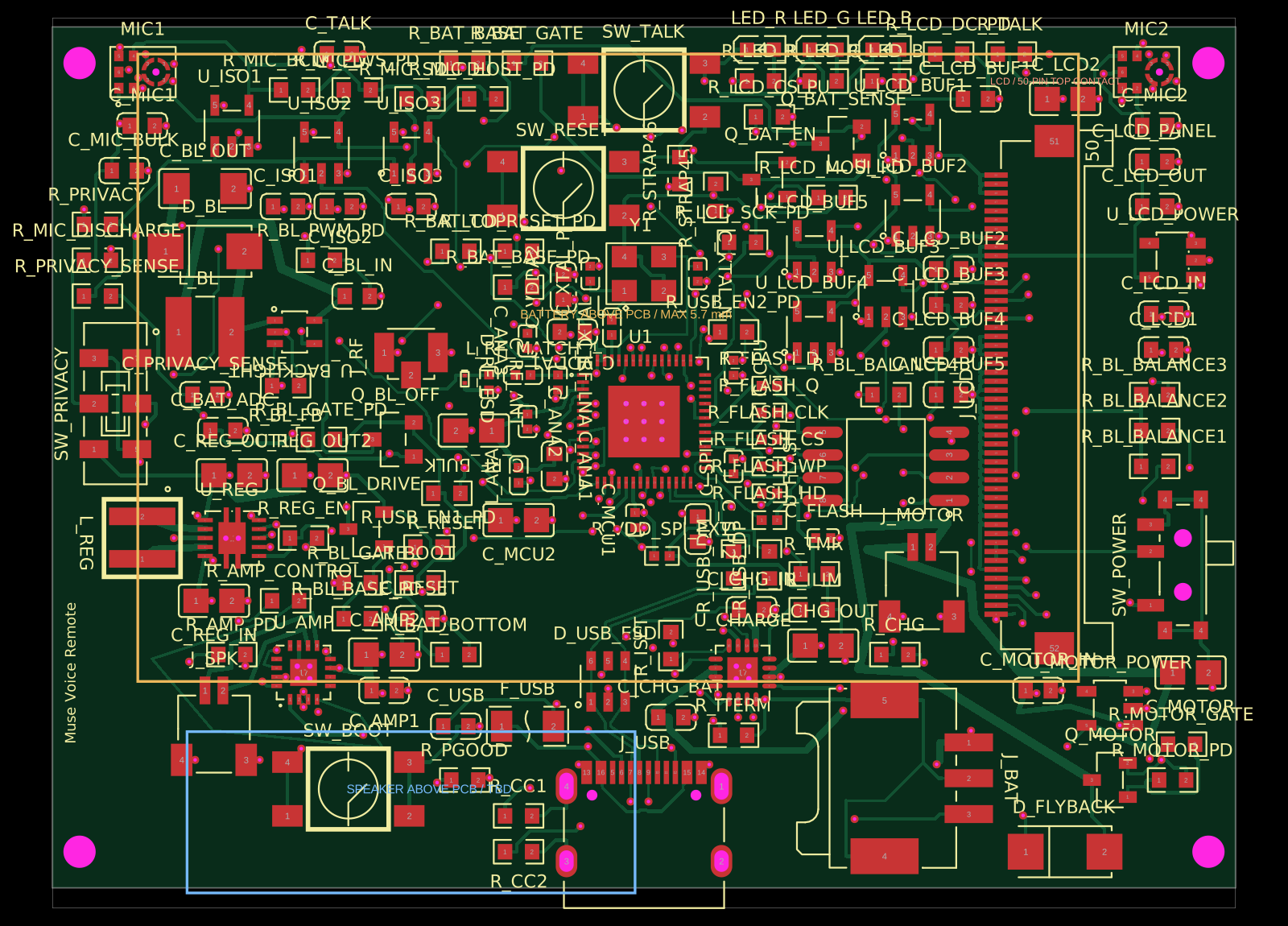 More from this authorAnasSarkiz/muse-voice-remoteMuse Voice Remote v1.3.0: checked prototype PCB/PCBA handoff. Bare ESP32-S3R8 chip, 155 TOP parts from 56 stocked JLCPCB imports with supplier CAD retained. Exact ER-TFT028A2-4 no-touch LCD, dual microphones, TALK, physical privacy, Wi-Fi, speaker, haptic and USB-C. Includes circuit.json, Gerbers/drills, JLC BOM/CPL, segmented stencil artwork and 19 filled/capped thermal-hole map. Native/factory DRC clean; 20 tests pass. See manufacturing/FABRICATION-NOTES.md for stackup and assembly requirements. Physical device/enclosure/RF qualification, firmware and connected-service MUSE integration remain unverified.
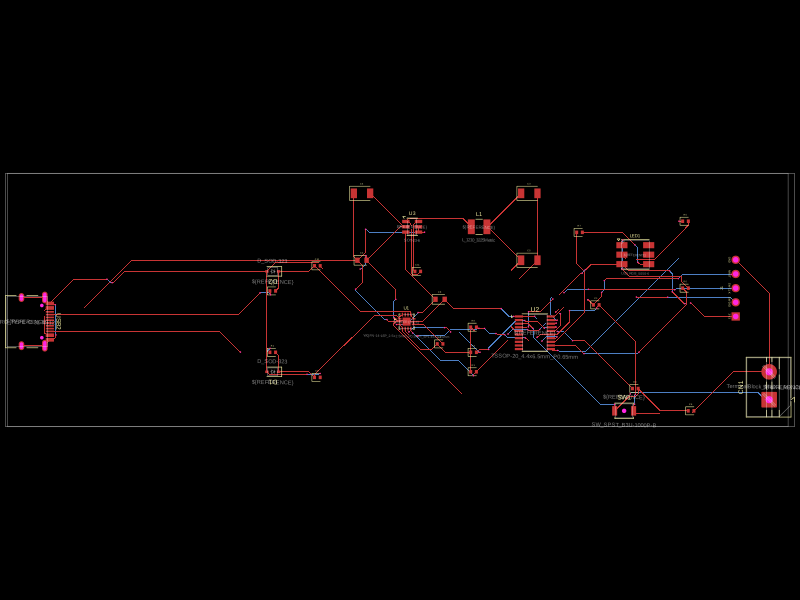 Similar packageaura/diy-power-delivery-triggerThis hardware design implements a USB Type-C port with supporting power management and signal conditioning components, including a USB-C connector, a FUSB302 USB-C port controller, ESD protection diodes, a buck converter for 3.3V power regulation, an STM32 microcontroller for control and processing, an RGB LED indicator, push button, terminal block connections, and associated filtering and support components.
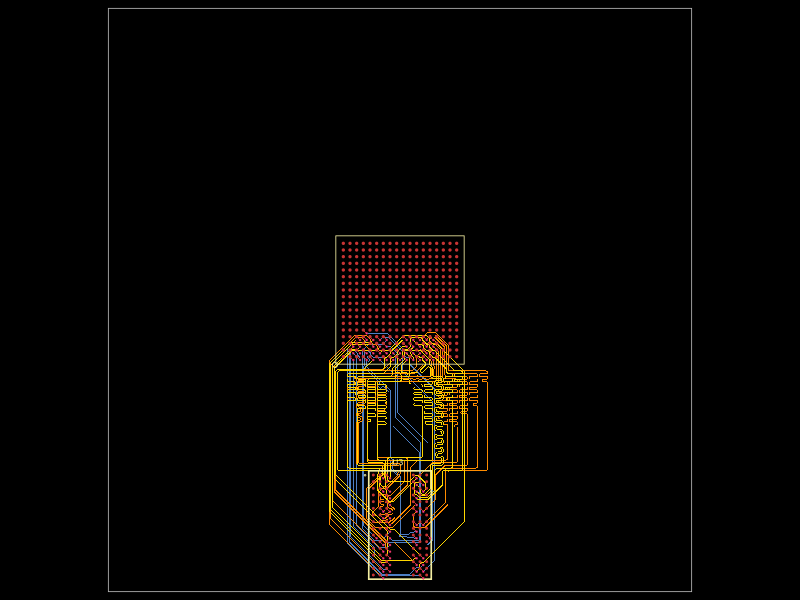 Discover something newseveibar/am3352-ram-dogbone-and-single-layer-route-testAM3352BZCZ100 processor connected to a W631GG6MB-12 DDR3 memory chip through a routed, length-matched 16-bit DDR interface with clock/data-strobe pairs and control/address signals.